

Graham Morrison
6 November 2026
Ubuntu Summit 26.10: Less than a week away!
Ubuntu Summit 26.10: Less than a week away!
Here in London, the long summer has stepped aside for cooler nights and damp, misty mornings. The trees are turning amber and the sunlight is low on the horizon, which can only mean one thing: the next Ubuntu Summit is just around the corner. In fact, it’s next week, Thursday and Friday, November 12-13.
This will be our third Summit since switching to our twice-yearly schedule. What initially seemed like a huge challenge, fitting a year of planning into six months, then starting again, has become a massive opportunity for those of us who put the event together.
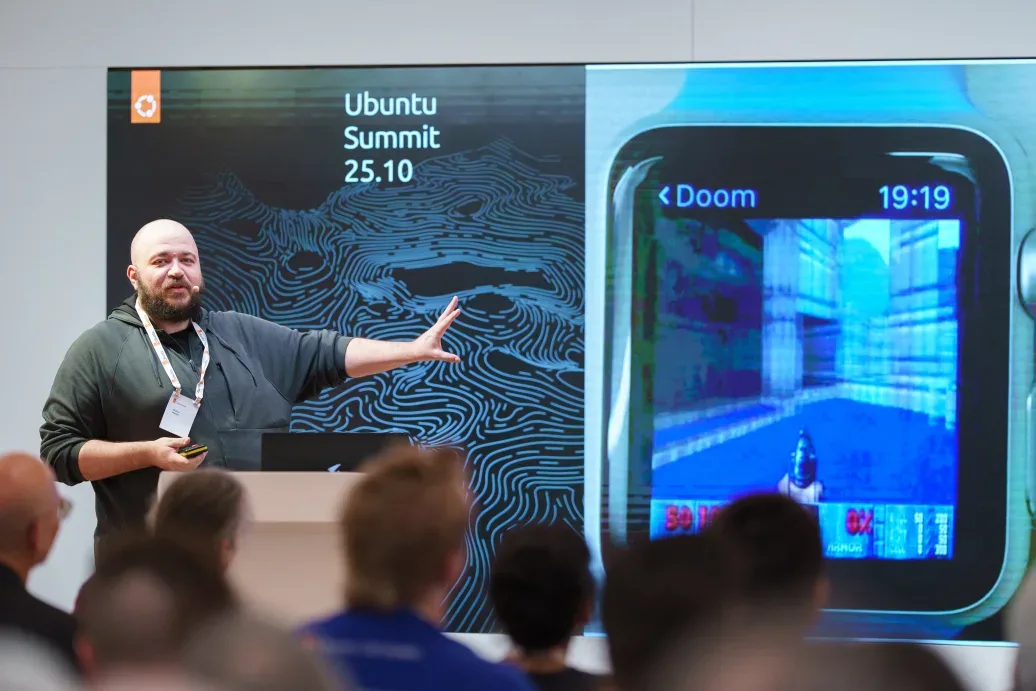
Much like the release early, release often software development philosophy (which many of our teams have adopted here at Canonical), frequency forces you to get good at what’s important. And what’s most important at a remote-first event like the Ubuntu Summit is the quality of the talks and presentations. With a fresh Summit every six months, we’re able to capture the best of what’s happening now and present the freshest ideas to the community. Never has moving fast been more important.
And because we are broadcasting a live, interactive stream from our base in London, you get to experience this immediately, whether you are watching at home or joining one of the local watch parties. You can ask questions to our speakers, take part in interactive activities, and poke around the latest open source developments without having to book a flight.
When you gather this often, conversations shift from distant, theoretical roadmaps to what people are actually designing, developing and deploying today. Our Ubuntu Summit 26.10 Timetable reflects this, which you can see from just the first morning’s sessions:
- Astra: an open-source observatory control software for exoplanet hunting: The development and application of open-source software used in astronomical observatories to detect and track exoplanets.
- ntfy: the joys of handling 4 million push notifications per day: An architectural overview of scaling backend infrastructure and managing high-throughput message delivery.
- hax: AI coding agent as a lightweight Unix tool: How to integrate large language models into traditional, terminal-based developer workflows using established Unix principles.
- How local AI is transforming Ubuntu accessibility: Our big news for Ubuntu – the integration of locally processed artificial intelligence models to improve user accessibility features within the desktop environment.
- Text to CAD: how I designed a robot with LLMs and open source tools: The practical application of open-source software and large language models in physical engineering and robotics design.
Register today (it’s free!) and we’ll see you next week.


